Humane slaughter has become a mainstream topic in the global shrimp industry, as retailers, certifiers, and consumers pay closer attention to welfare during harvest. In this Q&A, Shrimp Welfare Project’s Krzysztof Wojtas, Ph.D. unpacks what humane slaughter really means in practice, why it’s good for business and sustainability, and how producers and suppliers can prepare for the future.
First things first: what do you mean by ‘humane slaughter’ for shrimp?
Humane slaughter for any animal is generally defined as rendering the animal immediately unconscious and insensible to pain prior to slaughter. On a more technical level, that means the rapid induction of a state in which the animal is unable to experience pain, distress, or other aversive experiences, maintained until death occurs (EFSA, 2005; FAO, 2020).
Today, most farmed shrimps are killed in ice slurry or left to suffocate in air, which can take many minutes and potentially hours depending on temperature. These methods are increasingly viewed as inhumane from both a welfare and consumer-trust perspective.
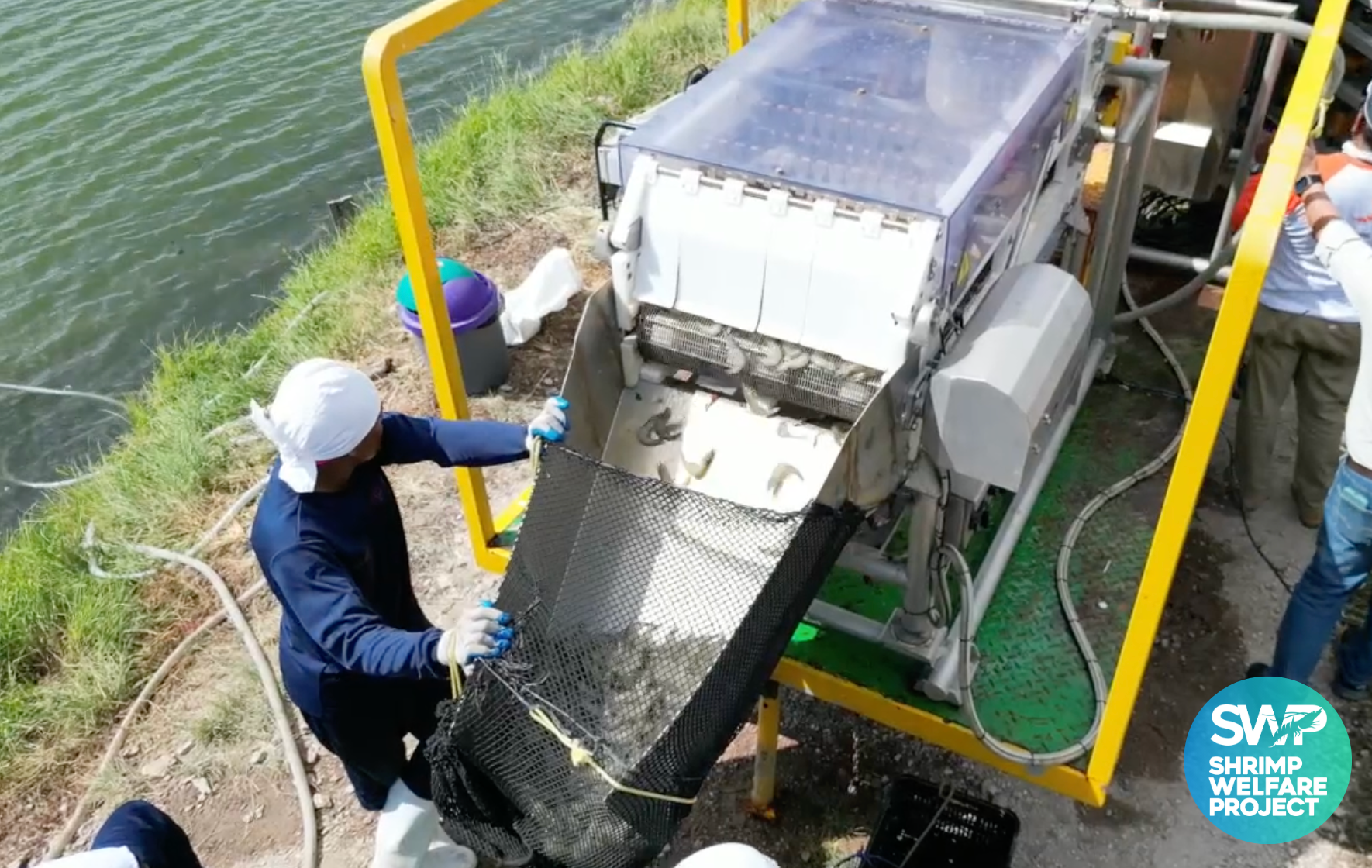
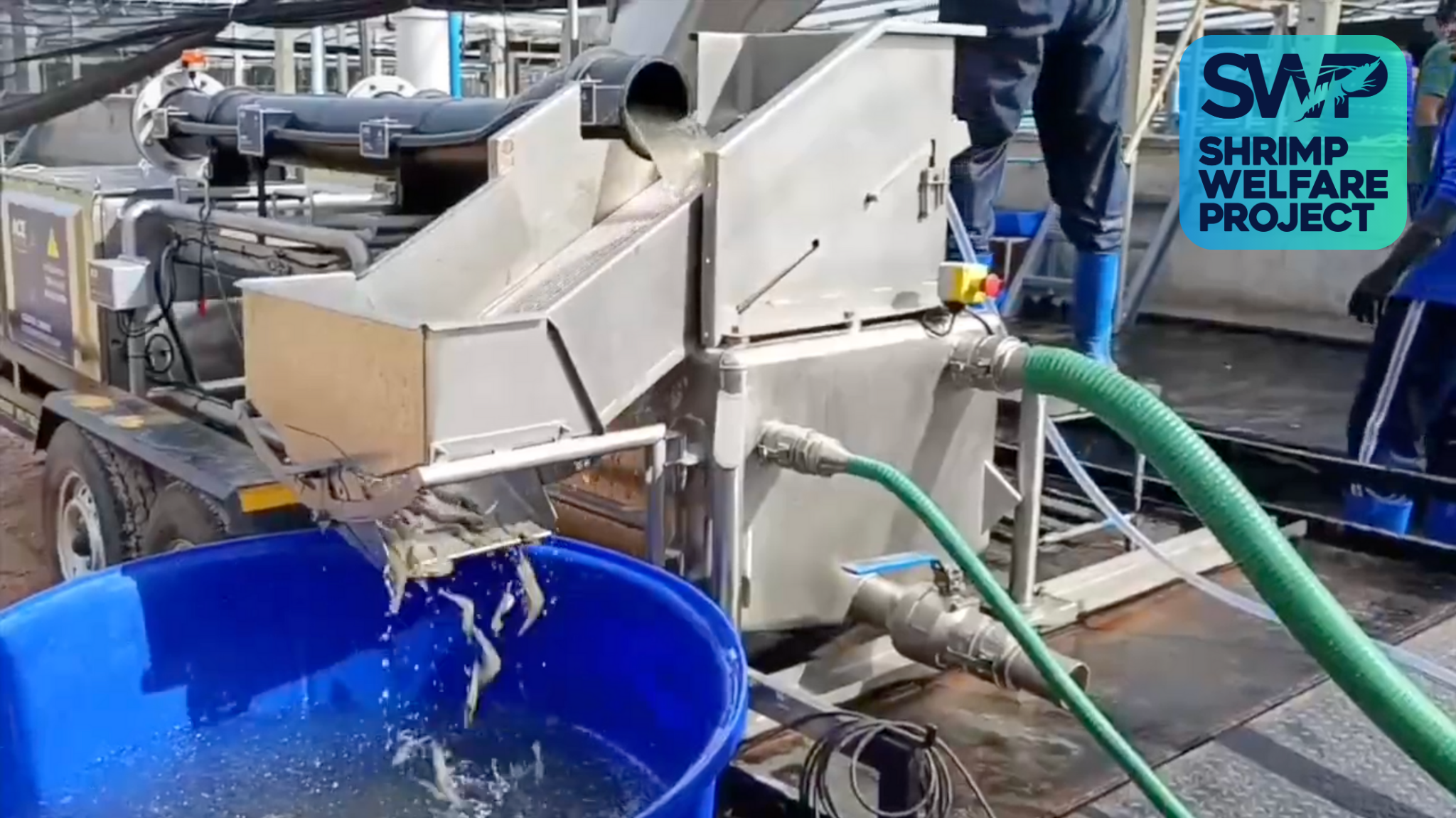
Based on analyses of slaughter methods, harvesting approaches, and scientific evidence, we’ve seen on farms across the globe that electrical stunning could be the most practical method for rendering shrimps unconscious within 1-2 seconds. While unconscious, shrimps are then transferred to an ice bath where they die without experiencing the prolonged distress associated with traditional harvest methods.
At Shrimp Welfare Project, we’re currently collaborating with academic researchers in an effort to get more peer-reviewed scientific data on electrical stunning. By studying biometric-based tests and on-farm trials, we can measure the impact of stunning on shrimps’ consciousness and refine best practices. The early results are promising, and ongoing work will continue to inform how we can help producers implement humane slaughter in different farm contexts.

What’s the business case for why producers should implement humane slaughter?
Humane slaughter is increasingly a market expectation. Many European retailers have already committed to sourcing shrimps that are stunned before slaughter, and more buyers are moving in this direction.
Plus, consumer sentiment is changing. Surveys in key markets show that many consumers view shrimps as sentient and are willing to pay more for products with higher welfare standards. Humane slaughter helps brands stay ahead of reputational and regulatory risk.
From a sustainability perspective, humane slaughter fits naturally into existing ESG and responsible aquaculture policies and commitments: it reduces avoidable suffering, aligns with legislation on decapod sentience, and signals to buyers that a producer takes animal welfare and responsible practices seriously. Certifications and auditors are also tightening scrutiny on slaughter practices; for example, the new ASC Farm Standard recognizes electrical stunning as one of the accepted methods.
Since Shrimp Welfare Project provides electrical stunners free-of-charge to qualifying producers, the barrier to trialling humane slaughter is low. That makes it a relatively easy “win” for producers who want to differentiate on quality and welfare by setting themselves apart as leaders in the global market.
You just mentioned that you give away electrical stunners, which certainly gets a lot of attention. Is Shrimp Welfare Project just ‘the charity that gives out free stunners’?
I certainly understand why it seems that way; if you’ve attended a conference or met with our team, it’s easy to remember us as “the stunner charity.” But our work is much more broad than that, so thank you for asking.
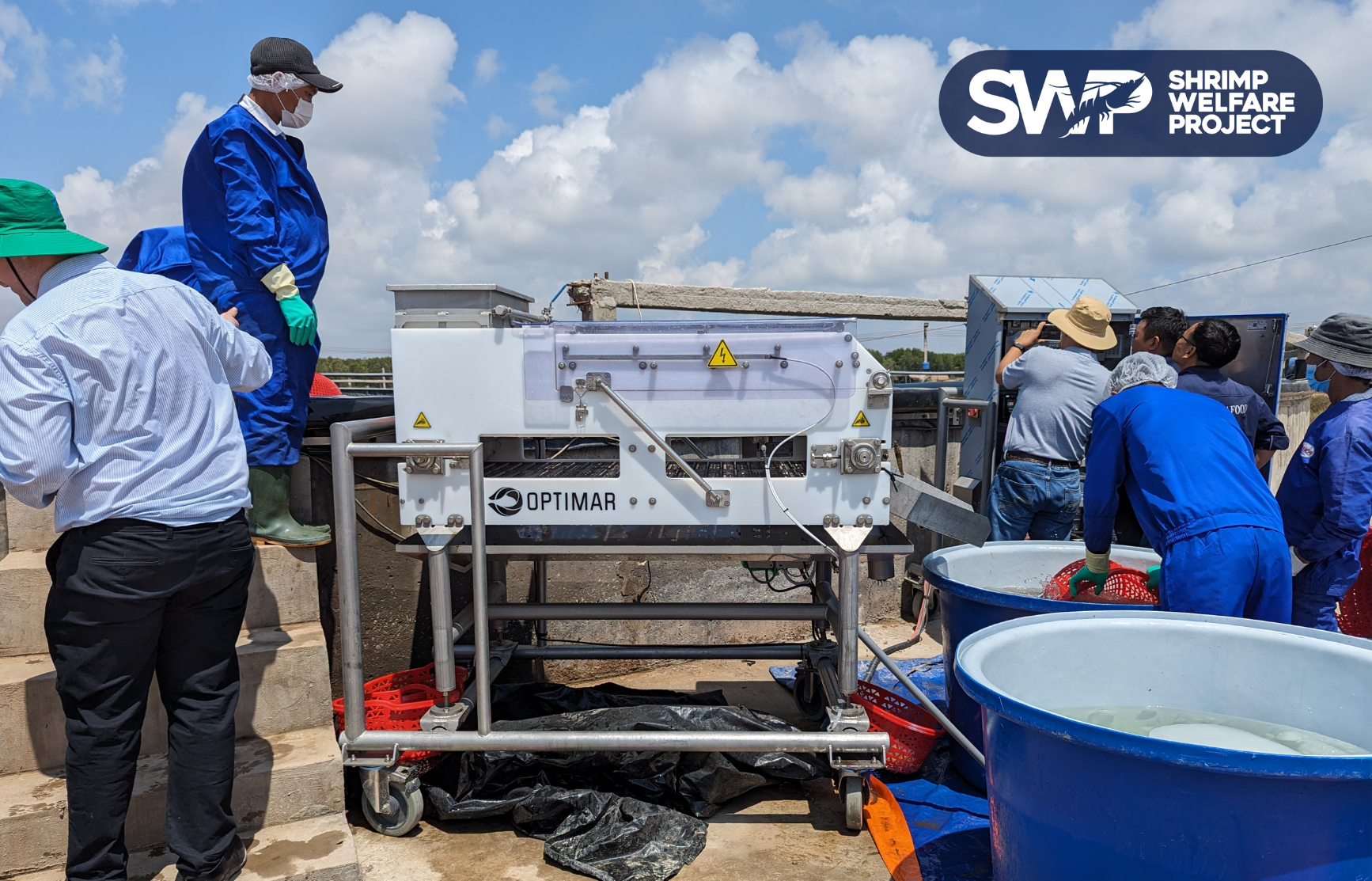
Our flagship programme is the Humane Slaughter Initiative which is a practical way to accelerate adoption of pre-slaughter stunning across the global industry. We provide electrical stunners and implementation support to medium and large producers who commit to using them at scale, typically stunning 1,900 to 2,900 tonnes per year.
But we’re also dedicated to broadening the scope of “humane slaughter,” beyond stunners. Increasingly, our conversations with producers cover the entire harvest process, as we’re actively looking to identify other opportunities for higher welfare, such as pre-stun handling and post-stun practices. We’re also aware of farm contexts where electrical stunning is not feasible, so we’re exploring evidence-based approaches to non-electrical stunning. We don’t want to leave behind smallholder farms or producers with narrow dikes who can’t transport a stunner to every pond, so we want to improve slaughter in those contexts. For example, “ice slurry” is frequently used as a broad label for cooling shrimps in water and ice, even though it encompasses a wide-range of practices – from well-designed, tightly controlled systems using fine ice particles and stable, low (often sub-zero) temperatures, to simple bins with large ice blocks where temperatures often remain relatively high. We’d like to help define best practices for chill killing protocols to ensure that shrimps don’t recover afterwards.
And that’s just the work that we’re doing in the Humane Slaughter Initiative. I haven’t even mentioned our other Corporate Engagement efforts to support higher welfare practices across the farming cycle, such as our Eyestalk Ablation-Free programme, where we shine a spotlight on producers who commit to non-ablated broodstock. We also support retailers in developing shrimp welfare policies and help connect them with suppliers and producers, so they can turn corporate commitments into practical changes in their supply chains.
Shrimp Welfare Project also has a smallholder farmer engagement programme in India, where we’re on the ground learning from these producers and helping solve problems on their farms, such as sludge removal. As I’ve mentioned, we coordinate and contribute to academic research on shrimp welfare, because we always take an evidence-based approach to our work. And we’re exploring market trends to identify future opportunities for supporting the industry’s transition to higher welfare. Basically, we help the shrimp farming industry improve welfare at every step of the way; no producer should ever feel like they’re doing this alone, and that’s why Shrimp Welfare Project is here.
What have you learned about challenges implementing electrical stunning?
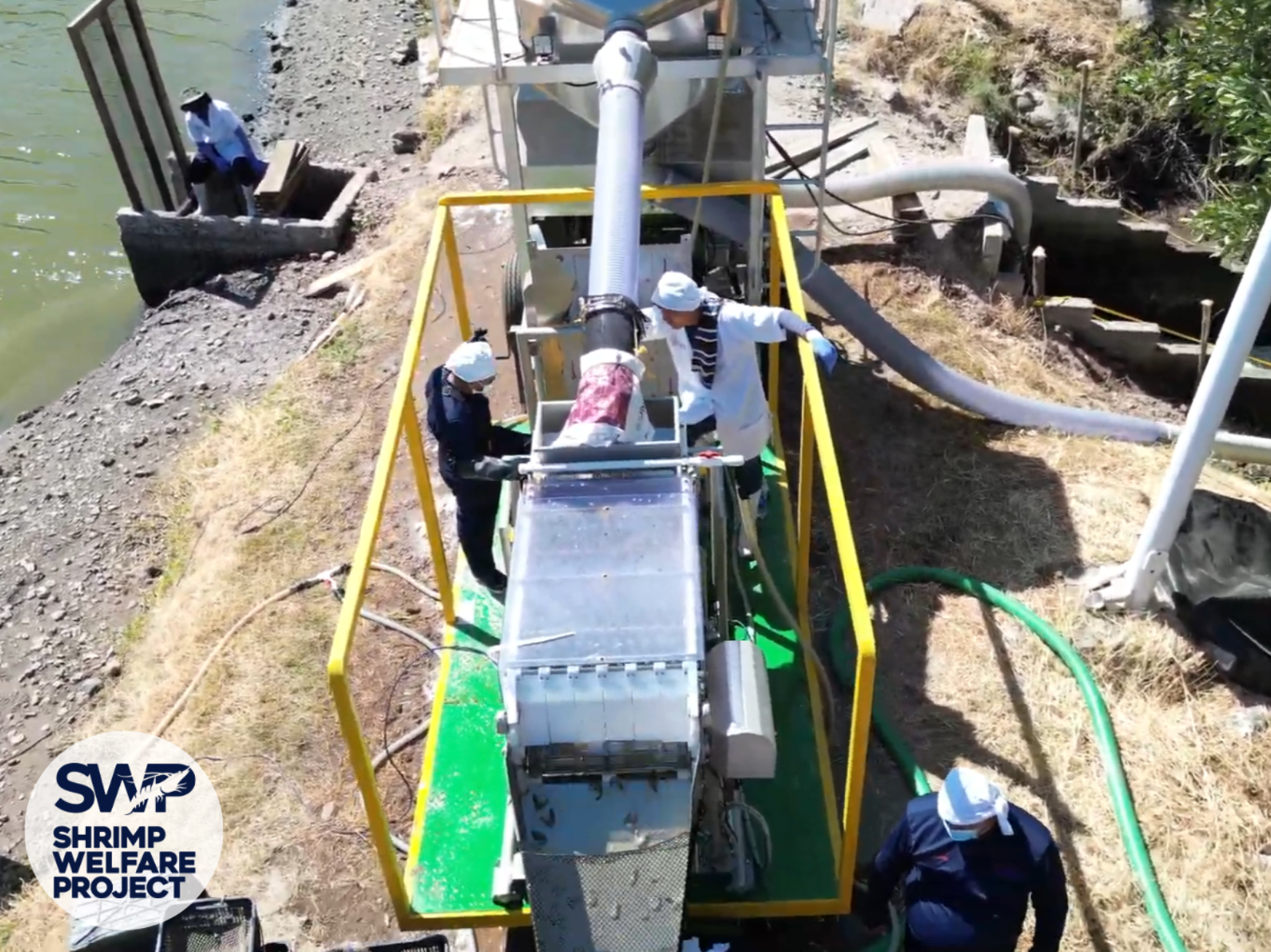
Since we started the Humane Slaughter Initiative in 2022, we’ve visited dozens of farms across geographic regions to see what works best on the ground. One of the biggest takeaways is that electrical stunning works best when integrated into a more automated harvest line. In particular, well-crafted harvesters can improve consistency and efficiency by delivering shrimps in a controlled flow, which in turn supports reliable stunning outcomes.
It’s important to note that shrimp stunning is still an emerging technology, and we’ve seen a lot of improvements over the last few years, such as higher-capacity units, more robust systems, and better user interfaces. There are still relatively few manufacturers of shrimp-specific stunners, and no single model fits every farm perfectly. Each site has its own constraints, depending on scale of production, pond layout, road infrastructure, etc. We often work with producers to adapt or tweak setups so they function reliably in real-world conditions.
Across different regions and farm contexts, higher-welfare harvest tends to share common features: minimizing handling and time out of water before stunning, avoiding crushing and overcrowding, quick and immediate stunning, and ensuring shrimps remain unconscious from stun to death.
What is the current state of evidence on shrimp sentience and humane slaughter?
The scientific consensus is moving strongly toward recognising shrimps and other decapod crustaceans as sentient, capable of experiencing pain and distress. This has been the finding of major reviews like the London School of Economics report for the UK government, and has already been reflected in legislation in countries such as the UK, Austria, Switzerland, and Norway.
There’s a growing body of evidence that shrimps react aversively to noxious stimuli, slow killing methods present serious welfare concerns, and well-implemented electrical stunning can rapidly reduce signs of consciousness.
But there is a “welfare gap” in the scientific literature, so open questions remain around how parameters should differ by species and size, how to best validate unconsciousness in field conditions, and long-term verification systems that are practical for producers and auditors. This is why we invest directly in research and field trials with academic partners and equipment manufacturers. We see our role as turning early scientific findings into practical, scalable protocols on farms, and feeding field experience back into the research agenda.
The bottom line is: The evidence we have today already justifies moving away from status-quo practices. Electrical stunning looks very promising, and we are committed to improving humane slaughter with you over time.
What has been the response from retailers?
The response from leading retailers has been overwhelmingly positive. As of today, 11 major retailers in Europe and the UK have published shrimp welfare policies calling for humane slaughter and eyestalk ablation-free. These commitments now cover the majority of the UK retail market and are expanding into other key countries.
We help a growing number of supermarkets to develop formal welfare policies and implementation plans, and we are in promising early conversations with retailers in North America as they see the direction of where shrimp welfare is headed globally.
Shrimp Welfare Project’s role is to be a supportive partner. We help retailers develop and refine shrimp welfare policies by understanding what is realistic for their supply chains and connecting them with producers who are already implementing electrical stunning. Once we sign confidentiality agreements and start looking at their existing suppliers, we see that they’re often already sourcing shrimps from producers in our Humane Slaughter Initiative. This makes committing to shrimp welfare a “no-brainer,” since it’s easier, quicker, and cheaper than they initially think.
Retailers consistently tell us that strong welfare policies, backed by credible implementation, are an asset for brand trust and ESG reporting. Humane slaughter is increasingly part of how they define “responsible” and “sustainable” shrimp.
Where is humane slaughter headed in the next 3-5 years?
Momentum is building. All the signals point in the same direction: more retailer commitments, new fit-for-context stunning technology, and greater public awareness of shrimp welfare. I envision that humane slaughter will only continue to be the norm throughout the global industry.
As such, we expect there to be a broader range of stunner options on the market, including next-generation designs for smaller farms and diverse harvest setups. There will also likely be more robust verification frameworks, so buyers and certifiers know that shrimps are being effectively stunned. And as additional research is conducted, I think the findings will strengthen the links between welfare, quality claims, and brand positioning.
Producers who move early stand to:
- Secure and deepen relationships with high-value buyers.
- Prepare ahead of regulatory and certification shifts.
- Build internal expertise in welfare that will be valuable long-term.
If a producer wants to get ahead of the curve rather than scrambling later, our advice is to start a conversation with your main buyers about welfare expectations. Map your current harvest process and identify where stunning could fit in, and explore pilot projects with partners like Shrimp Welfare Project to de-risk the transition.
How can producers and suppliers work with Shrimp Welfare Project?
Shrimp Welfare Project is an independent nonprofit dedicated exclusively to improving the lives of farmed shrimps in the most effective, evidence-based ways we can. Our goal is to make humane slaughter and higher-welfare farming practical and scalable, not just aspirational.
For producers, we can provide electrical stunners free-of-charge for qualifying farms, along with training and implementation support. We can also offer tailored advice on harvest design, pre- and post-stun handling, and higher-welfare practices in your specific context.
For suppliers and retailers, we can help develop or strengthen your shrimp welfare policies. Through personalized supply chain consulting, we can identify pathways to roll out humane slaughter among your existing producers and connect you with producers who are ready to lead on welfare.
Visit our website to learn more about our Humane Slaughter Initiative and how you can get involved. Get in touch with our team for a confidential, no-obligation conversation about your operations and what next steps could look like.